

History Repeating Itself?

No one likes change.
And Frederictonians were particularly resistant, especially when it came to time.
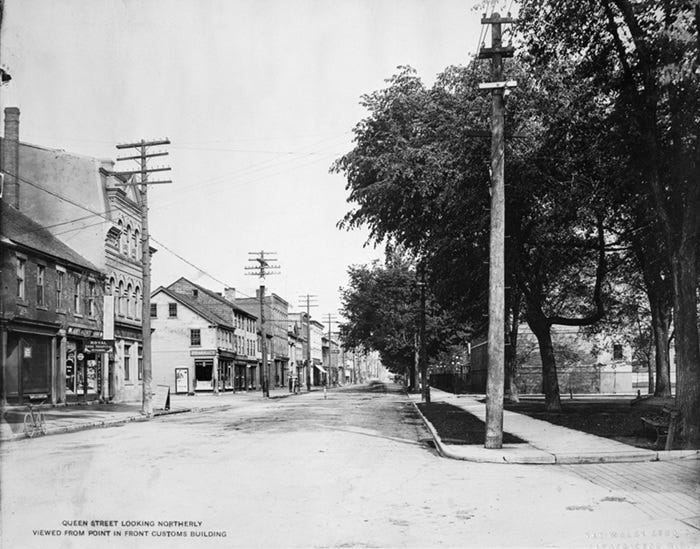
One month before photographer William A. Walsh captured this serene Queen Street scene, a powerful faction rose up in opposition to an unpopular decision made by Mayor and Council.
A decision reminiscent from the not-too-distant past.
Now it was Daylight Saving Time.
And in the present race against time, the question became:
Would history repeat itself?
The Year in Review
The Daylight Saving Time revolt joins a roster of largely forgotten local events from that year.
A Busy Bus
The new calendar was marked by the introduction of a novel type of carette.
Mounted on runners and drawn by two horses, the glassed-in bus attracted considerable attention. Not that carettes were new to the streets of Fredericton. A decade earlier, a carette once operated between Fredericton and St. Mary’s Ferry, shuttling passengers to special events across the river. The difference with this carette – it was still recognizable for what it once was: a concession stand.
Airmail
This was also the year that the first piece of airmail arrived in Fredericton.
Though much was made of this exciting new delivery system, the letter was only partly conveyed by air. The Handley-Page plane, the “Atlantic,” carried mail from Nova Scotia to the United States that fall – a first. Among the letters on board the flight from Halifax to New York was one bound for the John Palmer Company, on Argyle Street. Upon its arrival in New York, that letter was then sent by regular mail to Fredericton.
Students on Strike
Early in the school year, students at Fredericton High staged a walk-out after their petition for a half-holiday was denied. And in a show of solidarity, their teachers walked out with them.
The reason for the walk-out: the Exhibition.
At that time, the annual Provincial Exhibition alternated between Fredericton and Saint John – meaning that the thrills of the midway only came to Fredericton every other year. And this year, not only was it in the capital, but two airplanes were expected to land at the race track, near the exhibition grounds. Little wonder then that students wanted to go. But when their studiously-written petition, addressed to the School Board, fell on deaf ears, the students met in the high school assembly hall and marched out en mass.
And went straight to the exhibition grounds.
The students were to be disappointed in the airplane no-show, but it was still one of the best-attended exhibitions in years – with 11,500 passing through the gates that day.
High School teachers included.
Comedy of Errors
Early in the year, there were questions and confusion – both inside and outside the province – about changes in the rules of the road.
Enquiring minds wanted to know: were we switching from left to right?
Aware that discussions were underway, publishers of Hay’s Guide to Portland and Motoring in Maine contacted the New Brunswick government to verify that the switch was coming – wondering if it would be in time for the summer driving season. Although officials replied in the negative, the publishers printed the misinformation anyway.
The Maine press quickly picked up the story, telling their readers that New Brunswick was switching to the right.
And if that weren’t confusing enough, notices for a travelling show had many New Brunswickers reading these posters as instructions.
The name of that travelling show:
Turn to the Right
A musical comedy that had nothing to do with the rules of the road.
New Brunswick did not “turn to the right” that year, as the clews in this photo demonstrate.
First Clew
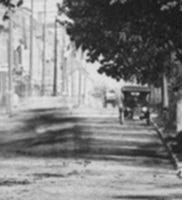
The Motor Cars
Both the parked car in the distance and the blurred one in transit are travelling on the left-hand side of Queen Street.
And if that weren’t convincing enough, there is an even better clew. The one in the middle of the street, providing the plain and simple directive:
Go Left.
Second Clew
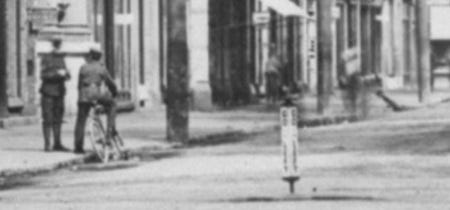
The Silent Policeman
The small, white pole with the red lettering – described even at the time as looking like a barber’s pole – had many names.
Sleeping Cop and Silent Cop were among them, but here they were known as Silent Policemen.
And these Silent Policeman stood in the middle of busy intersections, directing traffic.
This pioneering traffic sign served to remind motorists that there were two lanes, and that they were to be on the left side of the pole when making turns.
The Rules of the Road
Intersections had long been dangerous places – none more so than the one pictured here, corner of Queen and Carleton Street. Drivers, whether of carriages or motor cars, often cut the corner when making a right turn – narrowly avoiding a collision with oncoming traffic. The corner of Queen and Carleton was especially perilous as it funnelled traffic to and from the Highway Bridge.
The coming of the automobile did not prompt the city to update its traffic law right away, but the dawning recognition that the motor car was there to stay eventually called city fathers to action.
Until then Fredericton was guided by an antiquated piece of legislation – one that dated from 1824.
Drafted at a time when the greatest “mischief and inconvenience” on the streets arose from “the disorderly riding of horses and driving of carts, trucks and sleds,” the old law sought to eradicate “furious driving” by making it illegal “for any person to ride at full speed or gallop, any Horse, Mare, Gelding, Mule or Ass.” And for those at the helm of a wheeled carriage, they were not to “drive swifter than an easy trot.”
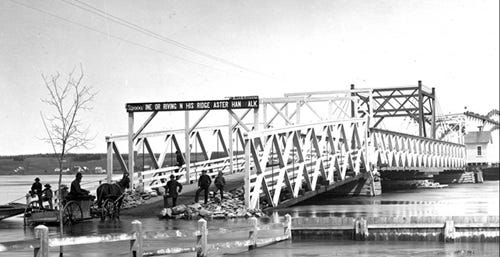
The same type of subjective speed limit – an obvious holdover from Fredericton’s 1824 traffic law – was imposed on the Highway Bridge (also known as the Carleton Street Bridge) after it was opened to passenger traffic in 1886. Bridge signage threated a $20 fine for crossing at a rate “faster than a walk.”
In 1916, City Council conducted a study of other municipal traffic laws, extracting what would work best for Fredericton. The resulting traffic law, adopted in 1917, vested in city police:
the control of the traffic and will be given instructions to enforce the provisions of the law, which is enacted to regulate all street traffic.
But given the city’s small police force, much of the traffic regulating – particularly at street corners – would be sub-contracted to their “colleagues,” the Silent Policemen.
Silent Policemen
In July 1917, four Silent Policemen arrived from Gloucester, Massachusetts and were quickly placed in position at York and King, York and Queen, Regent and Queen, and, of course, at Queen and Carleton.
The Silent Policemen were topped with red lanterns, lit at dusk, to make them visible at night.
Styles change, and during the 20-year career of Fredericton’s Silent Policemen, their appearance evolved with the times.
The second-generation of Silent Policemen – introduced in 1920 – were made more visible with the addition of two round discs, one on top of the other at right angles. Each circular disc instructed drivers to “Keep to the Left.”
In 1921, the city decided to increase its Silent Policeman presence by stationing two poles at various intersections – starting with the most contentious: Queen and Carleton. But because the additional Silent Policemen only created chaos and confusion, the city quickly reverted back to the single sentry system.
The following year, the Silent Policemen got a necessary facelift in anticipation of a long-awaited change (great news for Maine drivers). Re-painted in time for 1 December 1922, the Silent Policemen now read:
Keep to the Right.
A Silent Clew
The Silent Policeman guarding this dangerous corner was a first-generation traffic sign, on duty between 1917 and 1919. And a clew to narrowing that time frame – not just to the year, but to the week that William Walsh took this photo – can be found near the intersection.
The big poster.
On the Carleton Street side of Arthur J. Ryan’s drug store, there is a poster – largely washed out by the sun – advertising the screening of a motion picture starring a silent film legend.
Charles Ray.
Charles Ray’s star began to rise in 1917 when he signed with Paramount Pictures. His virile good looks guaranteed Charles Ray leading man status, and audiences flocked to theatres to watch his portrayal of an awe-shucks guy whose naïveté too often landed him in sticky, comedic situations.
Fame and fortune were his, and armed with both Charles left Paramount in 1920 to start his own production company. And even though he was directing and acting in films just like the ones that made him a star, the movies he produced simply did not strike a chord with audiences. And his bright star soon faded.
But this poster advertised a Paramount Pictures production, released at the height of Charles Ray’s career. And although the title – appearing right below his name – is virtually illegible, the number of words (3), including the last letter (R) in the third word, are evident with a fair bit of squinting while also consulting a list of Charles Ray’s movies.
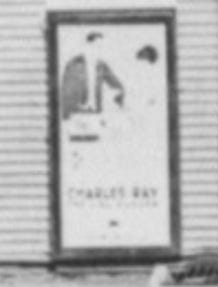
This poster advertised what was considered “the funniest picture” Charles Ray had made to date. That movie was:
The Girl Dodger.
Premiering in the United States in February 1919, The Girl Dodger was shown at Fredericton’s Gaiety Theatre just a few months later.
During the first week of June 1919.
One month after the conclusion of Fredericton’s great Daylight Saving Time debate.
Bright Lights, Big City
The proposed Daylight Saving Time, pushing the clocks ahead to extend daylight hours, appealed to Fredericton City Council looking to save on energy costs.
During the First World War, the city periodically cut the power to the street lights – a measure that did not sit well with constituents. Frederictonians enjoyed evening walks along Queen Street, called “The Great White Way” because of the brilliant beams cast by the light standards attached to the military fences.
When the new iron fence enclosing the Soldiers’ Barracks was completed in 1913, it came equipped with a series of light standards. Each standard had a bouquet of five bulbs, equal to the task of lighting up the night.
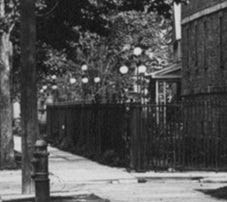
The first time the City Council shut the lights off along the Great White Way was in 1915. Although the public outcry was swift and fierce, it took the city more than three months to turn the lights back on. The power would once again be cut in 1917 to much the same result.
Even when these lights were off, Queen Street was not in complete darkness, and some suggested that City Council was relying too heavily upon merchants to keep the street aglow.
With their electric business signs.
Beginning in 1913, City Council outlawed hanging business signs that projected more than three feet from the building – prompting a move to vertical signage – but violations of the by-law were often overlooked if the sign were an electric one.
The city encouraged the installation of electric business signs from this point forward.
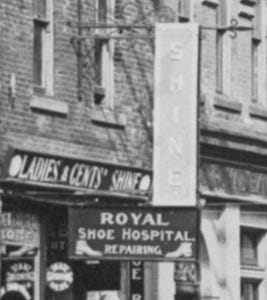
The Royal Shoe Hospital, located beside the Royal Bank of Canada (a gorgeous building completed in 1893), inherited its electric signage – that simply reads “Shine” – from the previous owner who had it installed in 1917.
For a City Council bent on cutting artificial lighting costs, Daylight Saving Time came at the right time.
Daylight Saving Time
Fredericton City Council entertained the idea of Daylight Saving Time as early as 1916 – the same year that Saint John actually adopted it (and continued for many years after without complaint). However, an apathetic response to a public meeting at Fredericton City Hall drew a paltry crowd of 18. It was just as well. Far too many residents still remembered what happened the last time Council dickered with time:
The city quickly dropped the matter, figuring that they would have a chance to re-visit the issue in the event that the Canadian Parliament made Daylight Saving Time “compulsory and universal.”
That time came in 1918, and Fredericton adopted Daylight Saving Time in April that year without a hitch. Unofficial polling suggested that residents enjoyed the long summer nights. When the clocks were returned to standard time on 1 November 1918, plans were already in the works to do the same the next year.
But when the time came in 1919 to adjust the clocks, there was considerable pushback. And not just in Fredericton. Parliament was also opposed to a repeat performance – among rural members most especially.
Daylight Saving Time simply did not work with the rhythms of farm life, and one of the most outspoken opponents in this province came from New Brunswick Farmers’ & Dairymen’s Association.
In this city, the Fredericton Labour Commission assumed a leading role in opposition to what was called “new time” – their membership preferring to stick with “old time.” As discussion and opposition to the new time heated up in early April, City Council decided to delay making a decision until the May Council meeting.
But in a surprise move that shocked everyone, Mayor Hanson proclaimed only days later that Fredericton would adopt Daylight Saving Time on Monday, 14 April 1919.
There was neither full agreement nor full compliance with the proclamation. While all public clocks – those at City Hall, the Cathedral, and the Post Office – were set one hour ahead, a number of factories remained on “old time.” Church leaders also opposed the time change, and Rev. Father Carney of St. Dunstan’s Catholic Church declared from the altar that it imposed “undue hardship upon the working classes.”
The Mayor’s abrupt decision galvanized the Fredericton Labour Commission. The Commission organized mass meetings, gathering the city’s clerks, carpenters, mechanics, and labourers – all of whom declared their strong opposition to Daylight Saving Time. The Commission leaned heavily on City Council, and under the onslaught, the Council agreed to hold a plebiscite.
When the votes were counted on 28 April, Daylight Saving Time was defeated.
The clocks went back on Monday, 5 May 1919.
And one month later – almost to the day – William Walsh framed this bucolic Queen Street scene, capturing a few locals quietly enjoying their time-honoured tradition of “old time.”
Frederictonians turned back time twice.
History did indeed repeat itself.
Credits
One year ago – almost to the day – Joshua Green, of the Provincial Archives of New Brunswick, provided me with a high-resolution copy of this William Walsh photo, and I have been examining it in detail ever since. It is a rich document, containing an abundance of historical threads, and I did my best to tie them all together.
So Canada used to drive on the left like England?
When did Daylight Savings Time get enacted? I hate it. Good for Fredericton for going on strike against it!
Fantastic decoding of an old photograph! It is indeed a rich document.